The Feed
Read daily effectiveness insights and the latest marketing news, curated by WARC’s editors.
You didn’t return any results. Please clear your filters.
GAT: Meta on track to surpass all linear TV spend


GAT: Meta on track to surpass all linear TV spend
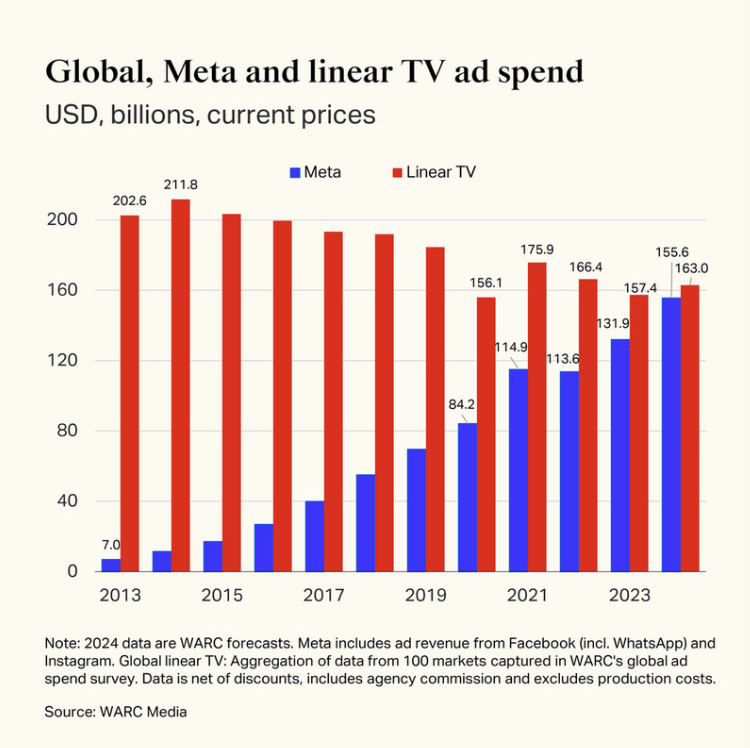
In just a few years, ad revenues going to Meta – owner of Facebook, Instagram, and Whatsapp – could outgrow the entire global linear TV industry, based on current trajectories; the findings of a new Global Ad Trends report indicate changes to global advertising as social media stands to become the world’s largest ad channel.
WARC Media members can find the full report here
If you’re not yet subscribed to WARC Media, you can access a sample of the report here.
Why social’s supremacy matters
Global social spend is set to total $247.3bn in 2024, up 14.3% year on year, ahead of paid search. This could see it grow to become the biggest advertising channel by spend.
But that’s a tussle among the new giants. Perhaps the more consequential shift is that on current trajectory, just the adspend going to Meta alone is set to earn more than the entire global linear TV industry.
It’s a moment that would signal a changing of the guard, not only from old media to new, but from a significant plurality of companies making money from global ad growth to a consolidated market dominated by global tech players.
What’s behind this
Both Facebook and Instagram grew by more than 20% year on year in Q1 2024, and Meta is forecast to earn $155.6bn in ad revenue this year.
- Tools like Meta’s Advantage+, which automates aspects of creative and media planning, are increasingly popular with advertisers.
- Meta reportedly increased its ad load in Q4 2023 to 19.1%, with most Reels sessions now having seven or more ads.
Elsewhere in the market
- The +18.3% year-on-year increase forecast for TikTok in 2024 marks a significant slow-down from the 87.8% growth rate it clocked up last year, despite the introduction of new search and shopping ad formats.
- Pinterest is set to enjoy a 17.3% year-on-year increase in ad revenue in 2024, while Snapchat is forecast to grow 13.7%.
- X’s ad revenue in 2024 is predicted to decline by 6.4% globally and 5.1% in the US – but this appears to be stabilising.
Editor’s view
“Much of social media’s success has been driven by Meta’s remarkable renaissance. However, social’s stronghold on budgets can also be seen in TikTok’s rise, and a return to double-digit ad revenue growth at Snapchat and Pinterest.
“However, with this dominance comes challenges, such as rising advertising loads in social environments, and the impact of AI on media planning. In this report, we take a holistic view of the global social media landscape, which shows no sign of losing momentum” – Alex Brownsell, Head of Content, WARC Media.
How to achieve peak performance and ROI in sports sponsorship
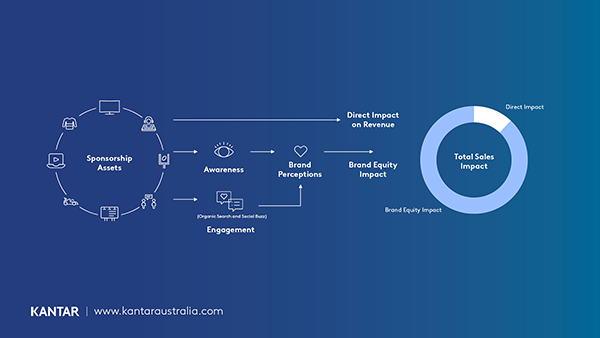
Sport in Australia is akin to religion, a vehicle for cultural aspirations and greater inclusivity, and sports sponsorship can help marketers to build upper-funnel metrics before conversion through emotive clarity and fan love.
Why sports sponsorship matters
Brand sponsors are the lifeblood of Aussie sports but they’re increasingly under scrutiny, with stakeholders questioning their true value. However, the focus should not be on evaluating immediate sales lift but on placing sponsorship in the realm of building upper-funnel metrics first and then conversion.
Takeaways
- Sponsorship is like a marathon, not a sprint, and capturing its impacts goes beyond measuring its direct...
This content is for subscribers only.
Sign in or book a demo to continue reading WARC’s unbiased, evidence-based insights that save you time and help you make marketing choices that work.

Crocs looks to marketing to boost HEYDUDE
Crocs reports that its two major brands are on different paths, with the Crocs clog brand growing while its HEYDUDE loafers brand is shrinking.
“They are definitely on different trajectories relative to the underlying market,” CEO Andrew Rees told an earnings call. “I think the underlying market is a reflection of the consumer spending less money on footwear,” he added.
Why it matters
If consumers are spending less, it suggests that marketing has to work harder, something Rees acknowledged: “We need to do a better job around engaging the consumer and making the HEYDUDE brand more relevant for more consumers,” he said.
In that respect, HEYDUDE will be taking a leaf out of the successful Crocs playbook, which is “to make the classic relevant for more consumers around the world”.
What Crocs has done
- Crocs operates a “socially-led, digital-first marketing playbook” which has kept the brand top of mind and popular with US teens, for example.
- It has driven brand affinity and engagement through partnerships, eg with Toy Story, Hello Kitty and Chinese streetwear brand Clot. A collaboration with luxury brand Simone Rocha was priced at $175-225 and sold out globally almost immediately.
- It has attracted new consumers through the creation of “multi-product franchises that broaden user occasions” (translation: think Echo Storm – an evolution of the clog to a sneaker).
What next?
Rees outlined three areas of focus for Crocs as a business:
- “Ignite our icons across both brands to drive awareness and global relevance for new and existing consumers”.
- “Drive market share gains across our Tier 1 markets through strategic investment behind talent, marketing, digital, and retail.”
- “Attract new consumers to our brands through methodically diversifying our product range and usage occasions.”
Sourced from Seeking Alpha

Behavioral science can be effective for promoting sustainability
Behavioral science can help the performance of ads that lead with an environmental message, improving their creative effectiveness by successfully encouraging consumers towards habits that positively change the environment.
Why behavioral science for messaging matters
As part of its Greenprint USA report, System1 analyzed 1,000 US TV ads and found that only 2.6% of them featured an environmental message. Those that did performed only slightly better than the US average across creative effectiveness metrics. With far too few corporations successfully addressing the climate crisis – or not addressing it all – finding ways to make environmental messaging...
This content is for subscribers only.
Sign in or book a demo to continue reading WARC’s unbiased, evidence-based insights that save you time and help you make marketing choices that work.
Why taglines are difficult to get right
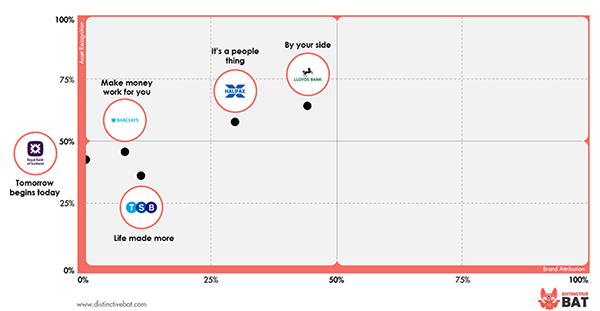
Taglines are often held up as one of the best examples of distinctive brand assets – think “Just Do It” or “I‘m Lovin‘ It” – but research shows just how difficult it is for taglines to stick in people’s minds.
Brand asset research agency Distinctive BAT analysed client research in the UK banking category and found that not one tagline reached ‘hero’ status – that is, at least 50% of respondents recognising it and at least 50% attributing it to the correct brand. Barclays, meanwhile, saw only 8% brand attribution and 43% asset recognition for its tagline.
Why distinctive brand assets...
This content is for subscribers only.
Sign in or book a demo to continue reading WARC’s unbiased, evidence-based insights that save you time and help you make marketing choices that work.

Marketing is a key influencer in price sensitivity
Pricing has been called the swiftest and strongest arrow in the marketer’s quiver, and revenue growth management is the latest discipline to drive sustainable, profitable growth through increasing and leveraging pricing power.
Product assortment and brand building are key to this end, and marketers should consider both the economics and the customer behavioral implications of marketing decisions, argues a professor of marketing at Northeastern University in a WARC exclusive, part of The WARC Guide to marketing’s impact on pricing.
Why pricing sensitivity matters
Consumers’ willingness to accept price increases is substantially moderated by brand strategies and category context....
This content is for subscribers only.
Sign in or book a demo to continue reading WARC’s unbiased, evidence-based insights that save you time and help you make marketing choices that work.

Chinese EV exports face brand hurdle in Western markets
Chinese EV exports face brand hurdle in Western markets
Taxes and tariffs pose a hurdle for China’s EV manufacturers seeking to expand into Western markets, but even if/when they get past those they will still need to address issues around brand recognition and trust.
Tariffs and taxes
- Imports of EVs from China to Europe currently face a 10% tariff, but this could at least double as the EU tackles what it sees as state subsidies to Chinese manufacturers.
- The US imposes a 27.5% tariff on all imported Chinese cars, but there is a push to increase tariffs on EVs or even ban them altogether.
- In addition, the UK and US are among several countries introducing new taxes or charges on EVs as they seek to replace lost tax revenues from fuel duties, actions which could significantly slow market growth.
Brand considerations
- The position of China’s EV manufacturers has been likened to that of Japan’s automakers in the 1970s and 80s, when Japanese brands were perceived as being inferior to their Western counterparts.
- Chinese manufacturers are arguably in a better position, having acquired Western brands like Volvo and MG. But that counts for little in terms of rapidly building credibility and trust when the marque being sold is unknown to buyers.
- Many markets don’t carry such baggage, especially across Southeast Asia where EVs are becoming increasingly popular.
- “Chinese EVs are flocking to fast-growing markets like Thailand in droves,” Jacky Chen, general manager of carmaker Jetour’s international business, told the South China Morning Post. “We have the huge potential to unseat conventional carmakers’ leading positions there.”
What can Chinese brands do?
Global Trade magazine suggests that Chinese automakers should initially focus on the fleet and rental markets, where cost is typically a more important consideration than brand. If they can generate significant sales in these markets then they can increase public familiarity, as well as amassing data on reliability, to be in a better position to penetrate the consumer market.
Sourced from South China Morning Post, Financial Times, Global Trade, BBC, Politico

Why purpose advertising isn’t always the best strategy
Why purpose advertising isn’t always the best strategy
Brands new to activism should be cautious of wading into controversial waters in an attempt to look purposeful, as consumers could potentially punish this behavior for not being credible, according to a new study.
Researchers in the United States found that the source of a message has a huge bearing on how it is perceived, with established activist brands such as Nike less likely to experience negative consumer backlash as a result of purpose advertising.
About the study
The researchers used three studies to reach their conclusions, examining attitudes and perceptions toward Nike and Ben & Jerry’s primarily – considered to be established activist brands – and contrasting their findings with emerging activist brands such as Asics and Breyers. The participants in the first two studies were college-aged American students, while a third study about Ben & Jerry’s was broader in its age range, making it more nationally representative.
In each study, a controversial message (low consensus) was contrasted with one that was less likely to trigger a divided response (high consensus). Issues explored included immigration and policing.
Why purposeful brands matter
The Association of National Advertisers named ‘purpose’ the word of the year in 2018. In the last decade, meanwhile, there has been a movement toward the idea that brands should have a reason for being beyond profit maximization. This has given rise to conscious consumerism, with people searching for brands that they believe align more with their values.
Takeaways
- Promoting a controversial message results in less favorable advertising outcomes, even for established activist brands.
- Established activist brands are perceived to be more credible than their emergent counterparts when advertising a message likely to be divisive, and this translates to more favorable brand attitudes and purchase intentions among consumers.
- Established activist brands are not immune to net-negative effects and backlash but they can generally absorb adverse outcomes better than those newer to activism.
- When brands take a stand on a contentious issue, part of the negative response arises from the idea that they don’t act the way they are expected to (or what the researchers called ‘expectancy violation’). A high-consensus message is more expected, such as brands talking about CSR.
- Brands such as Ben & Jerry’s, Nike, and Patagonia have a competitive advantage, particularly among individuals with a lot of knowledge of certain topics.
Sourced from the Journal of Advertising Research

Coty boosts marketing budget and earned media value
Coty boosts marketing budget and earned media value
An increased marketing budget and “overdrive on advocacy” on social media platforms helped deliver double-digit growth last quarter at Coty, a beauty company with brands including CoverGirl, Rimmel and Max Factor.
“Our focus in fiscal ‘24 has been on actively step-changing our social media reach in order to drive our brands and build stronger community engagement, underpinned by disruptive innovation,” CEO Sue Nabi told a Q3 earnings call. “We’re already seeing very strong positive impacts.”
Takeaways
- Advertising and consumer promotion investments represented approximately 28% of sales in Coty’s FY Q3, up approximately one percentage point from the prior year.
- CoverGirl reached the #3 rank for earned media value (EMV) in the US among the brand’s peer set (up from #6 last year), as product launches were amplified by thousands of influencers; EMV rose nearly 1.5x in the quarter.
- Rimmel reached the #4 rank for EMV in the UK among the brand’s peer set (up from #5 last year), as the brand worked with Rimmel’s Creator Crew to develop new products and launches and promote hero products; EMV growth was 75% in the quarter.
- That digital advocacy has also been an important factor in boosting sales via e-commerce channels which now account for 20% of all sales.
Why it matters
As Nabi explains it, in the context of CoverGirl, “distinctive brand equity, disruptive innovation and the strong momentum we are gaining in social media advocacy is allowing CoverGirl to outperform the established cosmetics brands at US mass retailers while simultaneously outperforming in e-commerce”.
Sourced from Seeking Alpha
[Image: Coty]

Shrinkflation is a global issue
Political leaders in France and the US have been publicly critical of companies for making products smaller while maintaining the existing price, but South Korea’s government is one of the first to legislate against it.
What’s happening
- The Korea Fair Trade Commission has said implementing such shrinkflation measures while not informing consumers constitutes an “unfair transaction” as consumers are forced to bear indirect price increases.
- It will now require producers that downsize products to put notices on packages, websites, or at stores for the three months following the change, Reuters reports. Failure to do so will incur fines.
Inflation concerns persist
- Inflation has come down from the heights of 2022 and 2023 but it continues to be a problem in many countries.
- In a recent Gallup poll, 41% of Americans cited cost of living and inflation as their top financial concern – far ahead of things like the cost of owning/renting a home (14%) or having enough money to service their debts (8%).
- In the UK, an analysis by the Financial Times found that consumers spent 15% more over the past two years while buying 0.5% fewer goods; food volumes were down 8% even as grocery spending rose 16%.
Why shrinkflation matters
From the French Revolution to the Arab Spring, high food prices are a trigger for social unrest. Only last month, South Korean President Yoon Suk Yeol announced food subsidies and cut tariffs on food imports as high prices and living costs resulted in his party suffering defeat in parliamentary elections.
Food and household goods brands, already having to tread carefully around the “woke” debate, may come under more pressure from politicians with one eye on their approval ratings.
Sourced from Reuters, Financial Times, Gallup

Reliance shakes up India's white goods market
With its entry into India’s white goods market, Reliance Industries is hoping to replicate the disruption it created in the telecoms market when it launched Jio.
What’s happening
- Reliance is establishing Wyzr as a domestic brand, initially in air conditioners but with plans to extend it into other white goods sectors and consumer electronics, according to reports.
- The first products will be made by contract manufacturers but the company aims to ultimately set up its own manufacturing facilities – leveraging the government’s Make in India initiative – as it develops products in-house.
- The target market for Wyzr products is budget-conscious consumers, with widespread distribution and awareness guaranteed by the Reliance store network.
Context
Big multinational brands, including LG, Samsung, Haier, Panasonic and Whirlpool, currently account for the majority of the white goods market in India. But they will be looking over their shoulder as Reliance offers products designed for Indian consumers and at prices likely to attract many first-time buyers.
Why it matters
The arrival of Wyzr is likely to provoke a reaction from existing players. “It will motivate brands across the spectrum to invest in real brand-building advertising as well as focused positioning as brands that care,” Ramesh Narayan, founder of Canco Advertising, told MediaNews4U.
Sourced from MediaNews4U, Economic Times

eBay in new focus on pre-owned fashion
eBay in new focus on pre-owned fashion
Pre-owned and refurbished goods reached 40% of total GMV on eBay during Q1, having consistently outpaced sales of brand-new goods since the pandemic.
CEO Jamie Iannone told an earnings call that a major priority for the online commerce platform in the year ahead would be “strengthening our consumer value proposition in pre-owned fashion”.
What eBay is doing
- eBay already has a partnership with the Love Island reality TV show in the UK, through which it has “grown awareness of the sustainability benefits of e-commerce, and educated consumers on the potential economic savings from shopping for pre-owned items” (this was also a Grand Prix winner in the 2023 WARC Awards for Effectiveness).
- In an attempt to “accelerate the circular economy”, it has streamlined the buying and selling experiences for pre-owned fashion on the platform, with an initial focus on the UK.
- A new AI-powered shopping feed, Explore, enables users to browse a nearly unlimited list of personalised recommendations based on implicit and explicit interest signals, such as the user's style preferences and sizes.
- ‘Shop the Look’ leverages generative AI to showcase a variety of styles which are linked to visually similar products on eBay live listings in fashion.
Why it matters
Founded back in 1995, eBay was a pioneer of e-commerce and peer-to-peer selling. Initially focused on collectors, it has since broadened its scope to include everything from luxury items to autoparts – both of which it defines as “focus categories”.
But 30% of eBay’s C2C sellers are in pre-owned apparel, where there are numerous competitors (Vinted, Depop, etc) and simplifying the selling/buying processes will be crucial to retaining users and, in turn, selling ad products (first-party ad revenue grew 28% in Q1).
Sourced from Seeking Alpha

Pfizer plans DTC site for medication
Pfizer plans DTC site for medication
Pfizer, the US-based pharma company, is said to be working on an online platform to order medicines, in an effort to commercialize a solution to the complexity of US healthcare, which is part of a wider strategy to go direct-to-consumer.
Why DTC pharma matters
Finding the right drugs at the right prices matters to consumers. Online channels are becoming critically important: one recent survey found that nearly 39% of US consumers expected to increase their online purchases of health products in 2024, while YouGov data from 2021 showed that more than half (51%) of US adults are comfortable buying prescription medicine online.
What’s going on
First reported by the FT, sources familiar with the company’s workings say the drug maker is planning to launch a website later this year that will connect patients to telehealth consultants (who prescribe the drugs) before a dispensing partner ships the product.
- Initially, medicines like the anti-Covid product Paxlovid and migraine medication will be available.
- The move follows an earlier effort from pharma firm Eli Lilly, which resulted in LillyDirect, a website supplying migraine treatments and weight-loss drugs, in partnership with online pharmacies.
In context
During Pfizer’s quarterly call with investors on Wednesday, US commercial officer Aamir Malik explained that “engaging and activating consumers is, as you pointed out, a very, very important part of our business.”
In a call announcing higher-than-expected profits, the company hoped to present itself as returning to form following a continued slump from Covid-era highs.
More broadly, the shifts to direct commerce by major pharma groups reflect a realization that there is big business to be found by transitioning more serious medication toward a consumer-style product (with, of course, a clinical layer in between).
Sourced from the FT, WARC, Reuters

Ad revenues are ‘growing fast’ at DoorDash
Food delivery business DoorDash reports ad revenue is growing fast and will exceed $100m this year.
While the business doesn’t disclose actual figures, CEO Tony Xu indicated on an earnings call that annual ad revenue would be “substantially larger” than the $100m punted by one analyst.
Takeaways
- DoorDash’s ad customers now extend beyond restaurants to include businesses in the grocery and retail sectors.
- It is also “seeing increasing pull from CPG advertisers” and is building out products to meet their demand.
- There’s a new focus on refining ad products to offer more self-serve capabilities and more reporting capabilities.
Why DoorDash ad revenues matter
CFO Ravi Inukonda highlighted how ad revenues are contributing to both revenue and EBITDA.
“Our goal has always been, how do we think about merchant ROAS as well as consumer conversion,” he said. “And we believe we are best-in-class for both of those. Those are the constraints we’re using to measure the quality of our ad business.”
Sourced from Seeking Alpha
[Image: DoorDash]

Marriott Bonvoy adds another 7 million members
Marriott Bonvoy adds another 7 million members
Marriott International’s Marriott Bonvoy loyalty program added another seven million members during Q1, bringing the total to 203 million.
Context
- Big hotel chains are seeking to lock in high-spending travelers through their loyalty programs and Marriott is currently leading the field, although Skift has estimated that it may be overtaken by Hilton by the end of this year.
- Marriott’s loyalty program is one of three “major systems” undergoing digital and technology transformation at the business – the other two being reservations and property management.
Why Bonvoy is important
- The sheer size of the loyalty program is clearly one factor, but CEO Tony Capuano believes that “engagement is a much more important facet of the program”.
- He highlighted in particular the growing credit card portfolio and the breadth of experiences on offer to members: “those are the powerful drivers of engagement”, he said during an earnings call.
- The business is also developing midscale brands at least partly in response to members looking for lower price points for certain types of trip.
Takeaways
- Member penetration of global room nights reached new highs in Q1, at 70% in the US and Canada, and 64% globally.
- Marriott Bonvoy has evolved to become a travel and loyalty platform, encompassing a portfolio of more than 30 brands across nearly 8,900 properties and other travel offerings.
- Marriott Bonvoy also spans numerous additional collaborations and member benefits, including co-brand credit cards in 11 markets.
Sourced from Seeking Alpha, Skift
[Image: Marriott Bonvoy]

What shall we watch tonight?
What shall we watch tonight?
The options for TV viewing have never been greater, but finding TV content, whether traditional or streaming, can be a frustrating and time-consuming endeavour for viewers.
How viewers find content
A report* from Comcast Advertising and FreeWheel highlights the issues:
- Only 25% of viewers surveyed say that all their content can be accessed in one place.
- Two-thirds of European viewers spend more than six minutes searching for something to watch; 46% say the difficulty in finding new content can get frustrating.
- Social circles play a big role in how viewers learn about new content: 51% of European (vs. 55% of American) viewers said they receive recommendations from friends, family, and colleagues.
- Viewers’ choices are impacted by situational factors, but genre is foundational: 75% of European viewers said that genre is a key factor in choosing what to watch.
- Channel surfing is still alive: 55% of European viewers start their content search by channel surfing or scrolling through a programme guide or app.
- Individual platforms play an important role in how viewers choose content: 53% of European viewers have found and watched content recommended on their home screen, highlighting how essential it is for content owners and advertisers to tap into this feature.
- Promos and native ads boost content consideration: 85% of US and European viewers are likely to be influenced to watch provider-recommended content if they had seen an ad or trailer previously.
Why it matters
With a huge volume of content available across multiple platforms and devices, consumers are overwhelmed with choice. Anything that enhances the discovery and navigation experience is likely to lead to more opportunity to engage viewers with relevant ads and build brand sentiment.
*Content Discovery in a Multiscreen TV World: Surfing and Scrolling in a Sea of Content analyses trends in how consumers navigate and discover content across traditional TV and streaming in the US and five European countries (UK, France, Germany, Spain, and Italy).
Sourced from FreeWheel
Amazon bullish on Prime Video ads
Q1 ad sales at Amazon were up 24% year-over-year to $11.824m, representing just over 8% of total net sales.
Why it matters
Other parts of Amazon’s business may be bigger, but advertising remains an important contributor to profitability in North America and internationally, CFO Brian Olsavsky told an earnings call.
Takeaways
- Ad growth was primarily driven by sponsored products, “supported by continued improvements in relevancy and measurement capabilities for advertisers”, said CEO Andrew Jassy.
- Amazon sees continued “significant opportunity” in sponsored products as well as in “areas where we’re just getting started like Prime Video ads”.
- Jassy believes that Prime Video ads offer brands value “as we can better link the impact of streaming TV advertising to business outcomes like product sales or subscription sign-ups, whether the brands sell on Amazon or not”.
Key quote
“I think advertisers are excited about being able to expand their ability to advertise with us in video beyond Twitch and Freevee to Prime Video shows [and] movies” – Andrew Jassy, CEO at Amazon.
Sourced from Seeking Alpha, Amazon

Why delayed gratification is key for Adidas
Why delayed gratification is key for Adidas
Adidas says it will be “disciplined” in its release of highly sought after trainer lines in order to keep demand (and therefore prices) high, as the sportswear company delivers better-than-expected results.
What’s going on
The company had around 8% revenue growth in the first quarter, and a significant return to big profits following a difficult post-Yeezy period.
The reason, says CEO Bjørn Gulden in a statement, is that the lifestyle segment, comprising some of its most desired and most venerable models, is driving that growth.
“The demand for our footwear franchises Samba, Gazelle, Spezial, and Campus is still very strong and growing.”
Leadership has maintained a firm line on buying in order to make sure both the brand and retailers are not over-inventoried. “We think that this year is about building a solid growth, building a quality growth, making sure that we and our retail partners don't need to discount.”
Maintaining control over pricing remains imperative.
The profit motive
Vitally, profitability grew 6.4% percentage points to a gross margin of 51.2%, the result of reduced discounting, healthier inventory, and a more favourable mix. In addition, in terms of raw numbers, the company is now lapping the drop in revenues that was the result from abandoning the Yeezy brand, following Ye’s controversial remarks.
But it’s worth digging into how the company is thinking about marketing as a key driver, having increased marketing by 9% in the quarter, all of which will push the percentage of marketing to sales to 12%.
“We still expect significant FX headwind. And as we said many times, we will continue to kind of overinvest in marketing and sales to build the momentum then to get the leverage as we grow,” Gulden recently told investors. “I'm very happy with the way things have developed in the last three months. It shows the strength of the brand and the strength of this company.”
In context
It’s a big year for sport with a Euros football competition and the Paris Olympics, and both events are expected to drive sales of performance lines. However, Adidas’s results follow the initially shocking news that the sports brand would no longer sponsor the German national team, as Nike agreed a much higher contract than the €50m that the deal had previously cost the brand.
Sourced from Adidas, Seeking Alpha

Pizza Hut changes direction in China
Pizza Hut changes direction in China
Pizza Hut, owned by Yum Holdings in China, is transforming from a premium casual dining brand to become a mass market operation, a direction that is reflected in its pricing policy.
What’s happening
- Joey Wat, CEO of Yum Holdings, told an earnings call that the brand was “ready for accelerated growth”, having added 400 new stores in the past year and increased city coverage by 10% to over 750 cities.
- “We aim to broaden its addressable market with a strong value proposition for mass market appeal,” he said. “Our strategy emphasises widening price points, expanding into new categories and delivering emotional value to consumers.”
- More products are now being offered at an “entry price” of less than RMB50; sales of such pizzas grew double digit in Q1.
- Similarly, more products are being targeted at the growing number of one-person meal occasions.
- “We are driving the ticket average lower at Pizza Hut,” Wat declared. “But our focus remains the same: driving incremental sales and focusing [on] profit and margins.”
Why it matters
China’s economy may have grown faster than expected in Q1, but consumer confidence is low. “Consumers are more rational in their spending in the new normal,” Wat acknowledged, “but they do respond well to our exciting offerings and campaigns.” That points to brands needing to be agile and able to respond to new trends as well as being timely and targeted in their marketing.
Key quote
“Urbanisation and long-term consumption upgrades in Tier 2 cities and below present a particularly attractive opportunity for us. Housing and living costs are more affordable there. Tremendous consumption potential has yet to be unleashed” – Joey Wat, CEO at Yum Holdings.
Sourced from Seeking Alpha, Yahoo! News
[Image: Pizza Hut]

Chinese youth embrace the single life
Chinese youth embrace the single life
A growing number of young Chinese are opting to live alone and stay unmarried, a lifestyle choice that’s affecting how they spend their money and driving a preference for niche brands over mega brands.
Why Chinese singles matter
China’s solo lifestyle movement is evolving alongside the country’s wider economic development. It’s influencing how young people shop, what they choose to do in their spare time, and the types of brands they prefer. While the Chinese government is implementing new policies to tackle its low birth rate, it might not be enough to counter the current trend and its economic implications.
What’s happening
“We’re seeing more young people embrace lifestyles that balance individual leisure time with work and what might be considered traditional family obligations,” Jacob Cooke, co-founder and CEO of marketing solutions platform WPIC Marketing & Technologies, told Jing Daily.
With more time to pursue hobbies and spend time with friends, young Chinese are spending more on items that complement a solo lifestyle, including pets and leisure sports, while valuing sustainability, self-care and healthy living, Cooke added.
Auction house Christie’s, meanwhile, has observed an uptick in young consumers from Asia. In 2023, the Asia-Pacific region accounted for 54% of Christie’s global new buyer spending, according to the South China Morning Post. The news service also reports that high-net-worth individuals in China are getting younger. The proportion under 40 years old has increased from 29% in 2019 to 49% in 2023.
Takeaways
- By 2035, China will be home to 400 million people aged 60 and above, comprising 30 percent of its total population, and making it one of the largest ‘senior single’ economies in the world.
- Women are increasingly choosing to stay single as their earning power grows, and their economic influence is contributing to new types of consumption.
- The rise of quiet luxury reflects changing lifestyles and values, with younger Chinese choosing more subtle expressions of luxury over flashier items from bigger brands.
- The Chinese government, meanwhile, is launching a ‘new era’ marriage and childbearing culture to counter its low birth rate across more than 20 cities.
Sourced from Jing Daily, South China Morning Post
Email this content
