The Feed
Read daily effectiveness insights and the latest marketing news, curated by WARC’s editors.
You didn’t return any results. Please clear your filters.

Growing market share: here’s what we know


Growing market share: here’s what we know
Whether you’re a leading brand, a challenger, or an upstart, market share growth is a critical objective of marketing – and WARC’s new report takes a look at some of the brands that have done it best.
‘What’s Working In Growing Market Share’ digs through WARC’s case study archives to showcase examples from household names including Proctor & Gamble and Uber Eats.
The importance of excess share of voice and attention
Increased advertising investment to build excess share of voice (ESOV) is strongly linked to market share growth, mental availability gains and a raft of other long-term success metrics for brands.
Long-standing research from the IPA and Nielsen indicates that an ‘average’ brand that increases its ‘share of voice’ by ten percentage points over and above its share of category sales typically enjoys an uptick of 0.5% in its total market share as a result.
By contrast, ceasing advertising spend (otherwise known as ‘going dark’) can cause double-digit value share declines over time.
What’s in the report
- Best-in-class case studies from Procter & Gamble, Samsung, Uber Eats, Lloyds Bank, Sipsmith, Centrum, Jif and Aldi.
- Why planning for attention – a proven driver of sales and market share – is essential to the next era of growth for brands.
- How a brand’s ‘share of search’ can be a leading indicator of market share.
- Why campaigns that offer ‘a promise to the customer’ drive market share movements of a higher magnitude than campaigns which do not offer a promise.
- How key theories of market share growth translate into e-commerce environments.
Read the full report on WARC now.

‘Encounters’-led planning adds new dimension to media quality debate
A report by Wavemaker UK argues that media planners should adopt an ‘encounters-first’ mindset when developing ad campaigns, concluding that TV remains the most cost-effective channel overall because of its high-completion rate and longer length.
From attention to signalling, the debate around the role of media quality – rather than audience targeting – in marketing effectiveness continues to grow.
Why do ‘encounters’ matter?
Metrics can be misleading when viewed through a singular lens; video formats do not allow for like-for-like comparison. TV reach delivery is based on impacts and is duration-based, while Meta, TikTok and Snap...
This content is for subscribers only.
Sign in or book a demo to continue reading WARC’s unbiased, evidence-based insights that save you time and help you make marketing choices that work.
When do startups need to start investing in brand to avoid a plateau?
When do startups need to start investing in brand to avoid a plateau?
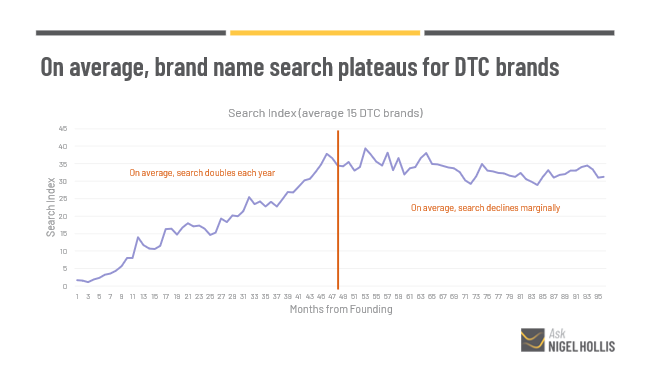
When do startups finally outgrow community- or product-led growth? Ideally, before returns from activation-focussed channels start to drop off - a period known as the performance plateau - a new analysis provides a solid answer.
The analysis by Nigel Hollis, author, consultant, and former Kantar chief analyst is fleshed out in a new blog, addressing ideas encountered in an earlier post, chimes with emerging thinking around the idea of brand as the creation of future demand as a critical objective for maturing startups.
What’s going on
Modern startups are often digital by design, and can often grown on the back of a mix of word of mouth and performance marketing to convert interest. Hollis’ analysis is based specifically on a basket of Direct-to-Consumer (DTC) brands and brand name searches over the 95 months following their founding.
“On average, brand name search doubles each year for the first 4 years. However, between years 4 and 5 the average trend changes dramatically and begins to trend down marginally,” Hollis writes.
“That means they need to start thinking about how best to build their brand at the end of the third year.”
In context
Hollis’ analysis will be of great use to early stage brands working out what to do next as well as to established brands looking to strengthen the argument for building demand.
It chimes with a framing of brand building in harder-nosed terms than ‘brand’, as explored by James Hurman in a WARC whitepaper in 2021 and fleshed out more broadly since then.
The thinking goes that when a radical new product (or channel, like DTC) arrives, a successful innovation will likely find a group of consumers that needed that problem solved but just needed a company to exist in order to buy.
Then, that natural pool of customers runs out and new customers become more difficult and expensive to find - Hurman noted that, anecdotally, this tends to happen around three years from launch. This is when you need to have started building future demand among an audience that is not ready to buy yet but may realistically come into the market in the future.
“When future demand creation and existing demand capture happen concurrently, growth is sustainable and sustained.”
Sourced from Ask Nigel Hollis, WARC. Image: Nigel Hollis

The AI perception gap
Artificial intelligence has been a part of the mainstream conversation since the arrival of OpenAI’s ChatGPT in late 2022, but while the technology is becoming more powerful, users are also coming to terms with its limitations.
The crux of the matter
Generative AI is understood to have great potential if you need to produce a lot of text or imagery. Using a publicly available beta version, like the free ChatGPT that many people have tried, obscures the big costs of running an AI system. This is especially true when models are much less accurate than they need to be, as they don’t have robust oversight over what AI systems are producing.
Cycles of hype follow a pretty predictable curve when excitement dissipates once the rubber hits the road and a technology’s limitations become clear.
Research points toward impact-optimised image generation
First, the good news. Lumen reports positive results from a trial of AI creative tools with Diageo which could be optimised for “difference” performance metrics. In this case, the attention the ads commanded were “significantly” more than in Lumen’s average benchmarks.
For marketers needing to generate not ideas but sheer output rather than creative strategies or platforms, the signals are positive.
Or at least, positive for a balance sheet. Lumen also notes a 2023 Kantar study showing that on certain brand metrics AI had the potential to be at least as good as human-made creative. On the surface, this looks a lot cheaper at the HR level.
But costs are ramping up. You may be able to sack your creatives, but with demand soaring for AI-skilled engineers there may be a different set of costs to consider. Not least environmental, as the sheer amount of computing power increases.
Stanford AI index: money and nerves
Concerns about cost will be clear to readers of Stanford’s AI Index, which puts some numbers behind the staggering computing costs needed to train an AI – costs that are only rising as models get bigger. “OpenAI’s GPT-4 used an estimated $78 million worth of compute to train, while Google’s Gemini Ultra cost $191 million for compute,” notes the AI Index report.
There is, admittedly, a lot of money flowing in. Funding for GenAI has octupled since 2022 to reach $25.2bn. But investors are not the public, 52% of whom express nervousness about AI coming to products and services – a 13% year-on-year increase.
With figures so large required, industry leads the academic or government in development by a long, long way. But industry brings with it challenges: companies need to make sure their models look (and, vitally, sound) impressive to clients and imposters. Robust, standardized evaluations of LLM responsibility are scant.
AI is going to take longer to generate returns than thought
Data from ETR, a research firm specialising in an ongoing panel of tech decision makers, finds that gaps in the rate of application of this new technology are emerging, despite the majority (80%) of companies surveyed having evaluated the potential applications of AI in their business.
Unsurprisingly, leadership tends to be much more optimistic than the experts, with some of the biggest gulfs found in the expected short-term returns (three months) – a timeframe in which 21% of C-suite leaders expect returns compared to just 10% of experts. This is based on a smaller subset of respondents at companies that have “implemented” generative AI features.
“I do think the hype cycle, because of how quickly it moved, the pendulum is stalling and swinging back a little bit,” explained Erik Bradley, ETR chief strategist and research director, in comments to Sherwood, a business news website. “People are recognizing it's still important, it's still going to be there. It might not be the panacea, the savior of their enterprise at this stage.”
Sourced from Lumen, WSJ, WARC, Stanford, Sherwood

London marathon greets a new cohort of fashion-forward running brands
London marathon greets a new cohort of fashion-forward running brands
Major sportswear brands have long blurred the line between function and fashion, but as long-distance running gains popularity, a new generation of design- and community- led brands are entering the running – and wider sportswear – space with a different playbook.
Many are looking to this weekend’s marathon and other running events later this season to deploy it.
Why sportswear matters
Dominated by major brands, the sportswear market has seen and anticipates consistent worldwide growth. While new upstarts share some of the same drivers as the big brands – distinctiveness and performance – they differ in their focus.
In part, they are looking at helping serious runners stand out, with the Financial Times calling it a “fashion week for the running community”. These efforts often end up tying encounters with a brand to a sense of participation and community. But they are also looking to a smaller, often more committed niche than the broad swathes of interest sought by the big players, as they wrap their logos around global events.
Availability, then, stems from the know-how, the reality of having earned your stripes as an athlete.
Fashion and performance chases a key consumer segment
Taken as part of a deeper athleisure trend, which is the fastest growing category in fashion, according to GWI, there’s a distinctly fruitful audience to be found here. As GWI’s Ben Butling wrote back in November, they tend to be affluent individuals “happy to gloss over a higher price tag if it means access to fashionable items that look good, have the quality to match, and make them feel a part of a social tribe.”
Brands at the edge
The FT foregrounds a handful of brands operating in this emergent design-led running space. There are upstarts, from creative people who spend a lot of time running, such as the clothing brands Soar, Satisfy, Pruzan and the apparel and eyewear brand District Vision. And then there are bigger brands like New Balance who will hold a fashion week-style party on the Thames to coincide with the London Marathon.
Why it works
The trend is interesting due to what one founder, Tim Soar of Soar, calls the “festivalisation” of the sport, including additional events like panel discussions and post-race after parties, complete with some brands stocking high-end finisher specific t-shirts that tie the brand and the product to the experience.
It’s a tried and tested method in the space, and follows a model of niche-led sustainable growth typified by the runner’s darling brand, Hoka.
Following a spike in the popularity of running over the pandemic, Hoka kept its distribution to specific shops to grow loyalty among the community of the sport and assiduously avoiding overstocking, unlike a lot of other brands offered on the mass market. This maintained the premium perception of the brand – and, of course, margins.
Background
The rise of design-led or fashion-forward running brands chimes with a longer term trend in fashion of urbanites in activewear, which The Cut termed Gorpcore back in 2017. (The ‘Gorp’ element refers to the popular American hiking snack ‘Good Old Raisins and Peanuts’.)
If you live in a city and have noticed a lot of urbanites wearing hardcore outdoor brands like Patagonia or Arc’teryx, it’s likely as a result of the rise of Gorp.
More recently, Cosmopolitan observed in January that the outdoor/performance trend has melded with the Succession-era tendency of quiet luxury, to form a kind of stealthy outdoors made up of eye-wateringly expensive performance gear.
Sourced from the FT, WARC, NY Mag, Cosmopolitan, GWI, Statista, Retail Brew. Image: Pruzan
McDonald’s: A creative effectiveness transformation journey
McDonald’s: A creative effectiveness transformation journey
Even brands as big as McDonald’s need to go through periods of reinvention and transformation, and for McDonald’s its most recent changes have been internal as well as external.
A new WARC Creative analysis takes a look at the impact of a re-prioritisation of creativity across the entire organisation, using data from the WARC Rankings and with commentary from a session the McDonald’s CMO, Morgan Flatley, gave at a recent WARC event in New York.
What’s changed?
McDonald’s has shifted in recent years from an extremely operationally focused organisation to one where creativity has a seat at the table in the boardroom and one that promotes creative courage. The fast food retailer can translate this directly into growth – $30bn in topline sales growth on a base of $100bn since the pandemic – outsized growth attributed to the focus on creative marketing.
The shift has resulted in the best year ever in the WARC Rankings for McDonald’s: 1st for effectiveness, 3rd for creativity and 3rd for media. And the first time a brand has ever ranked in the top three across all three rankings.
Why does it matter?
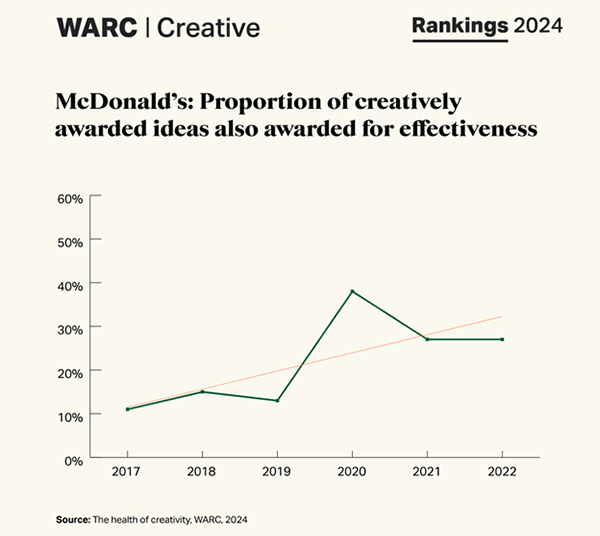
We know that creativity supercharges effectiveness from the many studies out there, but this is a specific brand example that can be linked to business growth. McDonald’s has increased the contribution of creativity to its effectiveness, raising the conversion rate from creatively-awarded work to effectiveness from 11% in 2017 to 27% in 2022.
A final word
“My advice is sometimes you have to take big swings in order to see that kind of momentum and help push an organisation out of what could potentially be a stuck moment to start to see the power of great creativity” – Morgan Flatley, CMO, McDonald’s.
WARC Creative members can read the full analysis here.

AdGreen triples measurement of ad productions in year two
AdGreen triples measurement of ad productions in year two
More companies are taking part in AdGreen’s efforts to track carbon production in advertising and more projects are being measured, according to the UK organisation’s latest annual review.
Key stats
- In 2023, the number of companies completing projects doubled from 2022, while the number of completed projects almost tripled to 1,424.
- 57% of top 30 UK creative agencies, and 72% of top 30 UK production agencies have contributed to a completed project. This is an increase of 10% and 33% respectively from 2022.
- Oliver takes the lead with 121 completed projects in 2023, and the greatest number of employees to complete AdGreen’s sustainable production training.
- There was a 1.5 tCO2e (metric tonnes of CO2 equivalent) increase in emissions in the average project size, compared to 2022, jumping to 6.2 tCO2e
- The average project size for productions with a budget over £50,000 per shoot day rose to 13.9 tCO2e, from 12.8 tCO2e.
- 72.1% of emissions recorded were attributed to travel and transport (air travel alone accounted for 60.2%), an increase of 9.7% from 2022.
Why advertising emissions matter
The latest data reiterates the need for the advertising industry to address unsustainable travel habits when creating content, particularly air travel, which generated 60% of the carbon emissions measured in the calculator in 2023.
And while generative AI may help solve some of these issues it’s by no means a silver bullet, as its environmental credentials are practically non-existent, consuming, as it does, huge amounts of electricity and water. A former Google executive has noted that “At some point the reality of the [electricity] grid is going to get in the way of AI.”
What next?
The AdGreen carbon calculator is being upgraded to include measurement of cloud storage, and virtual production where LED volumes are being used.
Sourced from AdGreen
[Image: AdGreen carbon calculator]

Events budgets are growing strongly
UK companies revised their marketing spend up once again in Q1 2024, with the latest IPA Bellwether Report showing events budgets expanding at the fastest rate on record.
Headline figures
- Almost a quarter (24.4%) of Bellwether panellists recorded an upward revision to their overall marketing budgets in Q1, compared to 15% that saw a contraction.
- The net balance fell to +9.4%, from +14.7% in Q4 2023, but this was still the second highest in almost two years.
By category
- Events was the stand-out category, recording a series-record expansion (net balance at +23.1%, from +15.9%) as companies continued to show a strong appetite for face-to-face engagement with customers.
- Direct marketing (+7.0%, from +12.6%) also extended its growth sequence, albeit with the upturn cooling slightly from its previous multi-year high.
- Sales promotions budget growth (+4.9%, from +1.4%) gathered further momentum in the opening quarter of 2024 – a possible red flag since overuse of promotions can undermine a brand’s profit margins and pricing power.
- Expansions of a marginal nature were seen in market research (+1.4%, from -5.0%) and PR (+0.6%, from +1.9%).
- Marketing budget declines were limited to just two categories in Q1, including the crucial main media segment (-0.7%, from +1.9%).
- Granular data on main media shows the contraction was driven by out of home (-10.8%, from -8.1%), published brands (-5.7%, from -1.4%) and audio (-4.5%, from -7.0%).
- This slightly offset growth in other online (+7.1%, from +13.2%) and video (+0.8%, from +6.6%).
Future plans
- Four in ten (40.7%) panellists have lifted the total amount available for marketing, compared to 18% reporting cuts. The resulting net balance of +22.8% signals strong budget-setting for 2024/25.
- The main area of marketing budget growth for 2024/25 is set to be events, with a robust net balance of +18.7% of survey respondents anticipating an uplift in spend compared to the previous financial year.
- Main media advertising is also poised for budget expansion in 2024/25, with a net balance of +10.1% planning to lift available expenditure in this segment.
- Market research (net balance of -4.4%), however, is set to contract.
- The Bellwether forecast for adspend to decline in real terms remains little-changed at -0.5% for 2024 (vs. -0.7% previously).
Sourced from IPA Bellwether
The Future of Measurement: four key trends
The Future of Measurement: four key trends
The evolution of measurement holds enormous and powerful potential for marketers, if the industry can overcome the state of decision paralysis – in an extensive new report, WARC identifies four areas to focus on with practical steps to help.
WARC’s Future of Measurement report is based on exclusive proprietary data as well as external research and reporting.
WARC members can read the full report here.
If you’re yet to subscribe, you can read a sample of the report here.
Why the future of measurement matters
Third-party cookies will finally be eliminated from online advertising this year, but only a tiny fraction of marketers are conducting holistic measurement, with a majority not using any modelling, explains Paul Stringer, WARC’s managing editor of research and insights, in an introduction to the report.
Four big ideas
The report explores four key trends across different chapters:
- AI and the growth of synthetic data
AI is set to transform market research, but the quality of output is only as good as the reliability of the data put in. Marketers will have to grow accustomed to deploying hybrid approaches. - The third-party cookie countdown
Though 75% of marketers understand their dependency on cookies, many remain unprepared for their end; interoperability of replacement systems is a big concern. - Hurdles in holistic measurement
MMM is a hugely exciting new step in measurement, but it requires some know-how to put into practice. - Closing the sustainability gap
Sustainability requires a more nuanced definition of growth, while new regulations will put pressure on brands to measure the emissions resulting from their activities.
Key quote
“With measurement continuing to evolve in several directions at once, marketers find themselves battling multiple headwinds: not only the demise of third-party cookies, but new regulations in sustainability reporting, and, of course, the growing influence and impact of AI” – Paul Stringer, Managing Editor, Research & Insights, WARC.

China’s tech giants power ahead on AI
China’s tech giants power ahead on AI
Recent announcements by China’s tech giants illustrate their different approaches to AI, with JD.com and Baidu trumpeting their proprietary tech while Alibaba is looking to the open-source development of its LLM.
What’s happening
- An avatar of JD.com’s founder and chairman, powered by the company’s ChatRhino AI, hosted two live-streaming sessions this week to promote consumer electronics devices and groceries.
- JD.com also reported that its AI-powered virtual streamers now cover more than 4,000 brands, according to the South China Morning Post.
- The Post also reports that Baidu’s Ernie Bot has gained over 200 million users, including 85,000 enterprise clients, in the 13 months since it launched.
- Alibaba reports that its Tongyi Qianwen LLM “has risen to a higher level than before” after it opened access to its 72-billion parameter version (Baidu’s CEO, however, believes there are too many open-source AIs in the market).
Why it matters
The debate on the best approach will no doubt continue but what’s already clear is that AI is going to reshape aspects of China’s digital life. JD.com claims its virtual streamers, for example, have slashed costs by as much as 90% compared to running sessions with human hosts, while the tech can also handle 70% of frequently asked questions. That spells trouble for the 15 million professional hosts working in the short video and livestreaming sector.
Key quote
“[The] LLM itself doesn’t create value directly, and only AI apps developed [using LLMs] can meet the real market demand” – Robin Li Yanhong, co-founder and chief executive at Baidu.
Sourced from South China Morning Post

Dove’s formula for purposeful creator tie-ups
Dove, the beauty brand owned by Unilever, is using a culture of feedback to build deeper relationships with its influencer community and further drive its brand purpose strategy.
Why impactful creator engagement matters
Working with influencers can enable brands to reach large audiences and drive awareness. Taking these relationships a step further, however, can have the effect of driving authenticity and engagement around a brand’s purpose, too. Achieving that goal rests on finding the right influencers and co-creating campaigns.
Takeaways
Firdaous El Honsali, Dove’s VP of external communications and sustainability, and beauty and wellbeing PR, influencer marketing lead at Unilever,...
This content is for subscribers only.
Sign in or book a demo to continue reading WARC’s unbiased, evidence-based insights that save you time and help you make marketing choices that work.

Aspirational buyers will accept higher prices, says LVMH
Aspirational buyers will accept higher prices, says LVMH
Top-end buyers in the luxury market haven’t been put off by price hikes and aspirational buyers will adjust in time, says the chief financial officer at LVMH.
What’s happened
- Jean-Jaques Guiony told an earnings call that currency movements and, more importantly, inflation, particularly in the US and Europe, had been behind some significant price rises (eg certain Vuitton products have almost doubled in price over the past five years).
- The business has taken advantage of strong demand to put prices up and maintain margins – “most of our competitors have been doing the same,” he noted.
- “I’m not particularly worried as to the acceptancy of the new level of price from aspirational customers,” he said. “It’s just that it is going to take time, as we can see on the markets.”
- And he rejected the idea that brands might design products aimed specifically at aspirational customers.
Why it matters
Price is one signifier of luxury and, wanting an air of exclusivity, any compromise here could dilute the image of a brand. With 42% of its revenues coming from Asia where inflation is not such an issue, LVMH would seem to be well placed to continue its brand marketing and wait for aspirational buyers to catch up.
Key quote
“This is not FMCG. The link between marketing investment and sales is not immediate and totally mathematic … we invest behind the brands to boost desirability [and] boosting desirability is an art and not a science” – Jean-Jacques Guiony, CFO at LVMH Moёt Hennessy.
Sourced from Seeking Alpha, LVMH Moёt Hennessy
[Image: LVMH]

Streaming and how it is redefining sports marketing in Australia
Streaming and how it is redefining sports marketing in Australia
Streaming tells compelling stories and drives cultural conversation, and the sports landscape has changed as streaming offers brands the opportunity to engage with a mass audience. This trend requires a more nuanced and integrated approach to marketing.
Why it matters
Sports streaming offers fans an unprecedented level of immersion, interactivity and personalisation that transform passive viewing into an active and engaging experience, one that allows brands to create a deeper connection with the audience.
Takeaways
- Streaming platforms can offer brands a unique proposition, allowing them to further embed themselves in the narrative of the sport itself by providing access to infinite content at their fingertips, exclusive and on-demand viewing, ancillary programming, and a personalised viewing experience.
- Contextually relevant creative enables the brand to appear more naturally within the sponsorship environment. In cases where contextually relevant creative was utilised, viewers perceived the brand as a more natural fit (+2%) and felt more favourable towards it due to the sponsorship (+7%).
- The future of sports advertising involves AI-powered contextually relevant ads that match the viewer's interests, timed with the flow of the game with little disruption.

IAB: US digital advertising grows on retail media, CTV, and audio
IAB: US digital advertising grows on retail media, CTV, and audio
US online advertising surged 7% in 2023 to reach $225 billion in revenue, according to the latest IAB figures, with an especially strong Q4 growth of 12%.
IAB Internet Advertising Revenue Report: Full Year 2023, conducted in partnership with PwC, is based on information reported directly to the professional services firm from companies selling advertising on the internet, as well as publicly available corporate data.
The “winners”, noted IAB CEO David Cohen in a statement, “were retail media, CTV, and audio, which saw the highest growth.”
Where the growth is coming from
- Retail Media revenues showed 16.3% YoY growth in advertising revenues, reaching $43.7 billion in 2023.
- Video advertising revenue experienced 10.6% YoY growth, rising to $52.1 billion; 42% of this came from Connected TV.
- Audio advertising grew 18.9% to reach $7 billion.
- Social media grew 8.7% year-on-year to reach $64.9 billion.
- Advertising revenues for search ($88.8 billion) and display ($66.1 billion) remain high, but at less stellar growth rates, with search at 5.2% and display at 4% YoY growth respectively.
Outlook for 2024
Privacy regulation, innovation, and generative AI are set to be the big stories affecting digital advertising in 2024, according to the IAB.
Key quote
“Looking ahead, while there are no shortage of challenges, there are also strong opportunities in sports streaming, creator-based marketing, retail media networks, and beyond,” said Jack Koch, senior vice president, Research and Insights, IAB.
Sourced from The IAB

Creativity with impact: Brand partnerships
Creativity with impact: Brand partnerships
Partnerships can boost the reach, resonance and impact of campaigns and are a key driver of effectiveness, as demonstrated in a new WARC report.
Creativity with impact: Use of partnerships in the WARC Rankings shines a light on three top campaigns in the recently released 2024 WARC Rankings – from CALM, eBay and Cheez-It – all of which utilise partnerships to drive campaign impact. It’s available exclusively to WARC Creative subscribers.
Why partnerships matter in boosting creative impact
Partnerships, in which two or more brands collaborate for mutual benefit, have become a powerful toolbox for marketers across all areas of brand building, from content creation and media strategy to sustainability efforts and product development.
Collaborative campaigns can boost brand awareness for both partners and enable a product or message to reach bigger and more relevant audiences. But the most effective partnerships go beyond short-term benefits. They utilise creativity, integration and multichannel ambition to deliver a whole range of additional outcomes, from enabling a brand to authentically engage a fan community to sparking a national conversation.
Takeaways
- Partnerships can deliver results across all aspects of brand building. All three 2024 WARC Rankings – Creative, Media and Effectiveness – featured brands which excelled by harnessing partnerships.
- Partnerships and sponsorships have become more ubiquitous and sophisticated, making creativity, unexpected insights, live moments and surprising media placements essential in order for campaigns to stand out.
- Within purpose-driven marketing, value-led collaborations can help brands gain credibility when tackling social and environmental subjects, and provide marketers with invaluable audience insights to ensure sensitivity around taboos.
- Partnerships with cultural icons can enable brands to enter cultural conversations and engage fans around their passion points. Within such campaigns, it’s crucial for brands to match their partners in terms of tone, language and media environment in order for it to feel authentic.
WARC Creative subscribers can get the full report here.

Organisational structures hamper transformation
Organisational structures hamper transformation
Data, tech and AI are relentlessly driving transformation at global brands, but 71% see organisational structure as the biggest obstacle to achieving successful change, according to a new MediaSense study.
Media 2025: Wave 6, the latest in a series of reports* from the independent media advisor, highlights how organisational structure is the most common stumbling block, ahead of capability/skillsets (57%), leadership/vision (49%) and budget management (40%).
Silos upon silos
- Most brands struggle to build an integrated marketing ecosystem because of pre-existing internal silos.
- As if that isn’t difficult enough, the report notes that many brands have to also break down silos within their agency’s organisation.
- 73% of global marketers say they are either in the early stages of, or midway through, their transformation journey.
Client-agency collaboration
- One outcome is that brands are starting to involve their agencies more closely with their business – and in return expect agencies to mirror their structure and support clients where they have limited resources and knowledge.
- That is changing the nature of the debate around in-housing, where the emphasis is shifting from execution to expertise: there is a focus on building capabilities across measurement, data, shopper/retail and media strategy.
- 50% of respondents say they are “very likely to change” an agency model based on business transformation.
- 40% believe their agency model has strengthened as a result of their transformation.
Towards greater effectiveness
- 26% of brands feel confident that they have generated incremental effectiveness as a result of their current transformation.
- 51% believe their organisations have become more consumer-centric over the last 12 months.
- 54% of advertisers cite “measurement and insight” as their top priority for the year ahead.
*MediaSense’s Media 20:20 program has run for ten years. The core data source of Wave 6 is both quantitative and qualitative research carried out over Q4 2023 to Q1 2024, among over 100 senior marketers (66% at CMO or director level).
Sourced from MediaSense

China’s bubble tea chains look overseas
China’s bubble tea chains look overseas
China’s leading bubble tea chains are heading to Hong Kong to raise money, with one eye on expansion into overseas markets.
Context
The bubble tea market in mainland China has become hugely competitive in recent years, and chains may see easier growth opportunities across Southeast Asia and beyond, where local markets are far less developed.
As one entrepreneur described it to KrAsia: “China’s tea beverage market has entered the stage of digital and intelligent transformation, while the Southeast Asian market still has the 1.0 model of single-store brands and chain brands in the capital phase.”
What’s happening
- Sichuan Baicha Baidao Industrial, which operates the 8,000-store ChaPanda chain, is looking to raise $330m in a Hong Kong IPO later this month.
- Baicha Baidao indicated that funds raised will go towards domestic expansion plans in China, including branding and promotional activities.
- Co-founder Wang Hongxue also remarked on the “huge potential” of overseas markets and flagged possible expansion into the coffee market.
- Earlier this year, rival chains Mixue Bingcheng and Guming also submitted applications for IPOs in Hong Kong (the Financial Times notes that proceeds from IPOs in Hong Kong can be more easily directed outside of mainland China).
Takeaways
- Within the Chinese mainland alone, the market for freshly made tea beverages was estimated at Rmb150bn ($20bn) in 2023.
- Bubble tea brands arguably have more appeal to Chinese consumers than coffee chains: not only do they play to the guochao idea and the country’s tea-drinking traditions, they are also endlessly innovative and, at around half the price of coffee offerings, they offer affordable indulgence.
- The focus for bubble tea brands tends to be on experiential aspects and attracting more male consumers, while for coffee chains it’s about the premium aspects of their business.
Final thought
How far does a cup of tea go? You need to watch the eastern wind, as it blows tea leaves around the world and sets the scene for the next thousand years.
Sourced from Financial Times, South China Morning Post, Reuters, Coffee Intelligence

How advertising impacts a company's stock price
Advertising generally has a positive impact on the value of a company and stock returns, by strengthening brand equity and brand quality, finds an analysis of research that spans several years.
While researchers concluded that successful marketing initiatives are recognised and rewarded by the investor community, they also suggested that there is room for marketing investments to drive even more value.
Context
More than 250 scientific articles on the topic of marketing and company value have appeared in leading journals since 2005. This study condenses these but it only examines publicly listed companies. One of the aims is to...
This content is for subscribers only.
Sign in or book a demo to continue reading WARC’s unbiased, evidence-based insights that save you time and help you make marketing choices that work.

Pernod Ricard China livestreams market research insights
The insights team at Pernod Ricard China used livestreaming to deliver the results of a comprehensive consumer study to internal stakeholders, a process that has since been rolled out across the entire business.
The researchers used storytelling techniques to present their main findings about consumers in China, borrowing their format from popular reality TV shows.
Context
The insights team at Pernod Ricard China conducted a comprehensive consumer study that was to lay the foundation for the brand’s five-year strategy and act as a guideline for business growth and development. The challenge was to deliver the findings in a memorable way...
This content is for subscribers only.
Sign in or book a demo to continue reading WARC’s unbiased, evidence-based insights that save you time and help you make marketing choices that work.

Axios plots a path through AI’s media evolution
Axios plots a path through AI’s media evolution
Axios, a news service with methods that have proved deeply influential to the idea of a modern media property – designed as it is around expertise and respect for its readers through an easy-to-skim style – has fascinating thoughts on the emergence of AI.
The New York Times reports some pretty blood-curdling commentary from Axios co-founder and CEO Jim VandeHei about the risks of artificial intelligence.
Quite simply, it’s going to “eviscerate the weak, the ordinary, the unprepared in media,” he argues.
Most news and information companies are unprepared, and most of the rules that would regulate the use of media companies’ output are still being written, let alone enforced.
How news organizations survive
The strategy, then, falls into several buckets – most of them are not particularly hi-tech:
- Expertise
- Membership programs tied to experts
- In-person events
What this looks like at the company that created the ‘Smart Brevity’ style is a big expansion in email newsletters focusing on high-cost, super-specific content built for professionals, with additional news and data available to subscribers as well as quarterly Q&A calls with writers.
Why it’s interesting
It’s not about tech. Axios’ observation appears to be that the tech is moving fast, too fast for a non-endemic company to realistically make a dent.
- Instead, the strategy revolves around an expansion of the areas in which the company already excels and making the link to an expert for professional level news.
- “The premium for people who can tell you things you do not know will only grow in importance, and no machine will do that,” VandeHei tells the NYT.
Axios has a major property in the advertising world – Sara Fischer’s Axios Media Trends newsletter – which has been a rare example of a media business that has grown by hiring more writers and pursuing local news (it now has 30 local newsletters around the US with two million subscribers).
Sourced from NYT, WARC
Email this content
