The Feed
Read daily effectiveness insights and the latest marketing news, curated by WARC’s editors.
You didn’t return any results. Please clear your filters.
The Future of Measurement: four key trends


The Future of Measurement: four key trends
The evolution of measurement holds enormous and powerful potential for marketers, if the industry can overcome the state of decision paralysis – in an extensive new report, WARC identifies four areas to focus on with practical steps to help.
WARC’s Future of Measurement report is based on exclusive proprietary data as well as external research and reporting.
WARC members can read the full report here.
If you’re yet to subscribe, you can read a sample of the report here.
Why the future of measurement matters
Third-party cookies will finally be eliminated from online advertising this year, but only a tiny fraction of marketers are conducting holistic measurement, with a majority not using any modelling, explains Paul Stringer, WARC’s managing editor of research and insights, in an introduction to the report.
Four big ideas
The report explores four key trends across different chapters:
- AI and the growth of synthetic data
AI is set to transform market research, but the quality of output is only as good as the reliability of the data put in. Marketers will have to grow accustomed to deploying hybrid approaches. - The third-party cookie countdown
Though 75% of marketers understand their dependency on cookies, many remain unprepared for their end; interoperability of replacement systems is a big concern. - Hurdles in holistic measurement
MMM is a hugely exciting new step in measurement, but it requires some know-how to put into practice. - Closing the sustainability gap
Sustainability requires a more nuanced definition of growth, while new regulations will put pressure on brands to measure the emissions resulting from their activities.
Key quote
“With measurement continuing to evolve in several directions at once, marketers find themselves battling multiple headwinds: not only the demise of third-party cookies, but new regulations in sustainability reporting, and, of course, the growing influence and impact of AI” – Paul Stringer, Managing Editor, Research & Insights, WARC.

How long do the profits from advertising take to materialise?
How long do the profits from advertising take to materialise?
Advertising has an average short-term profit ROI of £1.87 per pound invested which increases to £4.11 when sustained effects are included; a major new study concludes that 58% of advertising’s total profit generation happens after the first 13 weeks.
Context
Profit Ability 2: the new business case for advertising*, commissioned by TV industry body Thinkbox, is an update and expansion on a similar 2017 study, which found that TV ads drove 71% of advertising-generated profit.
The latest report analyses the profit generated by advertising at different stages as its effects build over time: immediate (within one week); short-term payback (up to 13 weeks); sustained payback (week 14 through to 24 months); and full payback (0-24 months).
Channel breakdown
- TV accounts for 54.7% of advertising’s full payback but only accounts for 43.6% of total advertising investment. Within this, Linear TV accounts for 46.6% of full payback and BVOD accounts for 8.2%.
- Online Video (which is mostly YouTube) has an average full profit ROI of £3.86 for every pound spent and accounts for 3.4% of full advertising-generated profit.
- Generic PPC (unbranded online search) offers the highest immediate payback, but its effects rapidly diminish after the first week and it has a weak sustained payback.
- Linear TV is the second strongest performer for immediate payback, followed by Paid Social, Audio and BVOD.
- TV also has the highest saturation point: advertisers can increase investment here to a higher level than other media and it will continue to generate a profitable return.
ROI varies by sector
- Full profit ROI varies by sector: in the automotive sector, for example, it’s £4.65 per pound invested, more than double the figure for the financial services sector (£1.95).
- That’s down to nuances in the different business environments, including the value of products, operating margins and the relative strength of advertising on sales.
Why advertising payback matters
“This is about the strength of advertising as a business investment that grows the bottom line and grows the economy,” said Matt Hill, research and planning director at Thinkbox.
* The study was produced by Ebiquity, EssenceMediacom, Gain Theory, Mindshare, and Wavemaker UK, using their huge econometric databases of client data. The final report covers £1.8bn of media investment in the UK across 10 media, 141 brands, and 14 categories.
Sourced from Thinkbox
CTV and podcast spending surges
CTV and podcast spending surges
British advertisers are increasingly tapping into the popularity of online entertainment, as can be seen from rising expenditure on CTV and podcasts, according to the latest Digital Adspend report from IAB UK.
Key stats
- Overall, the UK’s digital ad market grew 11% to a total of £29.6bn last year – far ahead of GDP growth of 0.1%.
- Ad spend on CTV devices grew 21% YoY in 2023, while the amount invested in podcast advertising was up 23%; social video continued to perform strongly with annual growth of 20%.
- Growth rates in all three categories outperformed the digital ad market as a whole, underscoring the appeal of these channels, which stand to be more immune to upcoming cookie changes than other forms of digital advertising.
- Digital out-of-home, included for the first time, grew 12% in 2023 to £841m.
- Digital retail media spend was also up 12% to £283m, as the sector continues to prove a popular route for advertisers looking to tap into retailers’ wealth of first-party data.
- Spend on mobile advertising has accelerated, increasing 15% to £16.7bn. This is a significant uptick versus 2022 when it slowed to a 4% growth rate in the wake of Apple’s IDFA changes.
- Search continues to underpin the industry, accounting for 50% of the market at £14.7bn.
- Display grew 12% to £11.3bn fuelled by video, which accounted for over 60% of total display spend for the first time.
Putting the data in context
“With the impending deprecation of third-party cookies, digital advertising is undergoing a shift and we know that the year ahead will reshape the industry in new ways,” said James Chandler, CMO at IAB UK. “In that context, it’s encouraging to see advertisers seeking out engaged environments and increasingly investing in a broad array of online solutions.”
Sourced from IAB UK
Revolut & Chase: The retail media boom comes to banking
Revolut & Chase: The retail media boom comes to banking
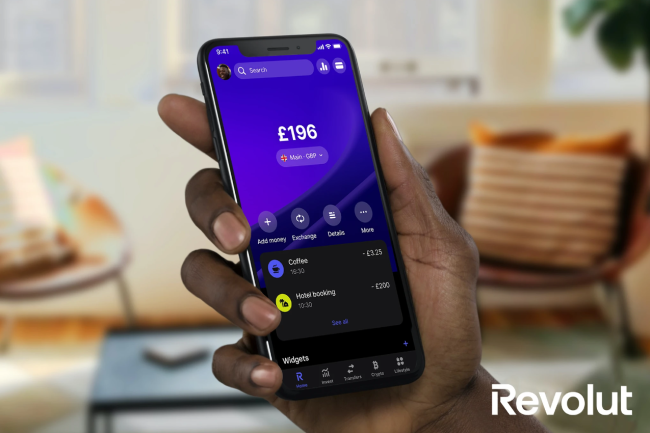
Financial services brands are starting to see opportunities in advertising, with Chase in the US launching a media solution and the UK’s Revolut considering one, as the same first-party storm that hit the retail world now gathers above financial services.
Why advertising matters to financial services
Selling digital ads is usually much more profitable than providing a company’s core operations because the incremental revenue is a byproduct of those operations. With young fintechs like Revolut looking for new sources of profitable revenue and established brands like Chase also in search of profitable growth, advertising appears to offer a big opportunity.
It’s not the first time that financial services and, specifically JPMorgan Chase, have dabbled in media. Back in 2021, it acquired restaurant reviews site The Infatuation. It appears that for Chase, at least, the strategy has yielded some rewards.
Revolut sees potential in media as fintech boom fades
No longer the radical upstarts of the late 2010s, fintechs or neo banks like Revolut are becoming established (even if it waits for a full banking license). But it too has felt the pull of media.
In an interview with the FT, Revolut head of growth Antoine Le Nel talked up becoming a “media business” capable of bringing in a “proper chunk” of total revenues. Internal company files shared by another source indicate that expected revenues from the project in just two years could be as much as a third of Revolut’s £923m revenues in 2022.
The company has now hired TikTok’s former head of e-commerce partnerships in the UK, Inam Mahmood, to lead sales for the new venture, indicating some seriousness.
Chase Media Solutions
In short, Chase Media will send its customers targeted deals and discounts based on their spending habits, adding a new level of sophistication and targeting to the existing Chase Offers feature. And this is thanks to the 2022 acquisition of Figg, a card-linked marketing platform.
According to a release, Chase Media Solutions “serves as a key conduit for brands, connecting them with consumers’ personal passions and interests.” At launch, the banks says it has piloted the technology through some short campaigns for Air Canada, Solo Stove, Blue Bottle and Whataburger.
In turn, the release continues, “Chase customers benefit from personalized offers and the ability to earn cash back with brands they love or are discovering for the first time.”
“Like retailers, we have first-party data and a dedicated audience. But what sets us apart is the unrivaled scale and insights from our customers,” says Rich Muhlstock, president of the new media solutions division.
Driving the story: Everything is an ad network
For the original thinking on this trend, which began in the depths of the pandemic, look to Eric Seufert’s observations on his Mobiledevmemo blog and the long list of examples confirming them.
The deprecation of the third-party cookie has floated on the horizon for many years now, as online advertising looks past the deeply flawed but democratic tracking technology of the cookie. Though there remain more potential hiccups along the way to a Google-sponsored solution, it is undeniable that marketers and media owners need to look to their own sources of data, known as first-party data.
It’s the story that makes up a significant portion of WARC’s latest Future of Measurement report (members can read here; if you’re yet to subscribe, get a sample here). At the brand level, this manifests in 71% of brands, agencies, and publishers increasing their first-party assets.
What’s new here, however, is how wildly the definition of “publisher” is deviating from its original sense, as advertising dollars fall away from their traditional destinations alongside professionally produced content. What matters to ad buyers today is audience data close to the point of purchase – for financial services brands, the step makes a lot of sense.
Sourced from the FT, Chase, WARC, Mobiledevmemo
Gaming: How to create immersive and effective brand experiences
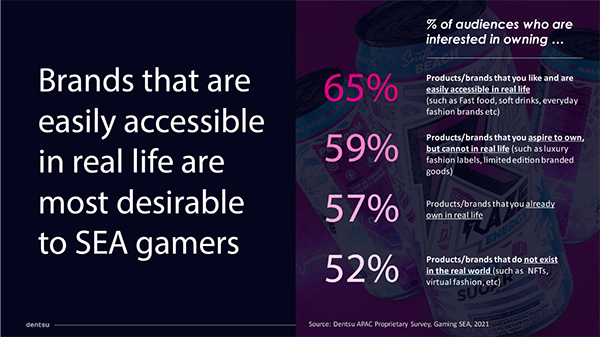
As traditional gaming arenas evolve into immersive, multi-sensory and multi-form social spaces, brands have the opportunity to curate personalised and lasting experiences to engage meaningfully with the lucrative US$5 billion gaming market in Southeast Asia and its 270 million gamers.
Why immersive brand experiences matter
Brands can build AI-enabled non-player characters to develop relationships with audiences in new ways to provide personalised and interactive real-time consumer experiences that allow AI to learn more about the consumer and conversation.
Takeaways
- Extend IRL occasions with exclusive in-game experiences and benefits to bridge the gap between virtual entertainment and real-world consumption.
- Non-player character (NPC)...
This content is for subscribers only.
Sign in or book a demo to continue reading WARC’s unbiased, evidence-based insights that save you time and help you make marketing choices that work.

How FIFA Women’s World Cup became a cultural phenomenon
How FIFA Women’s World Cup became a cultural phenomenon
FIFA’s brief for the Women’s World Cup was to create a promotional strategy to raise awareness, appeal, excitement and attendance with the ultimate conversion metric of selling two million tickets, elevating it beyond a sports tournament into a sociocultural movement.
Why the World Cup matters
To appeal to and convert the sizeable audience base of non-traditional football fans, the FIFA Women's World Cup had to behave more like a culture brand and lean into creating engaging content and experiences beyond the game that spoke to broader communities who could be convinced to participate in the tournament.
Takeaways
- Create enduring cultural narratives with wide appeal through on and off-the-pitch stories to connect with various types of traditional and new audiences.
- Drive fame through the power of sound, such as creating a unifying chant designed to transcend team allegiances and embody the spirit of greatness and inclusiveness that Australia and New Zealand are known for.
- Integral to the campaign was a made-for-social brand campaign aptly named Greatness Feeds Greatness. This underscored the profound impact of football on a global scale and reinforced the message of inclusivity and empowerment by creating different versions per audience and market.

How to maximise brands' engagement with sport
Marketers looking to make an impact during big sporting events could benefit from tapping influencer content and sports-adjacent celebrity buzz alongside tentpole events.
Why sports strategy matters
Sports is a key consumer engagement point for brands. Tentpole events can be the heart of this strategy, but the range of options has multiplied into everything from online highlights and creator content to a growing amount of celebrity-focused material that is adjacent to sports.
Takeaways
- Major sporting occasions like the Super Bowl offer significant reach on television, but a growing universe of related content opportunities is now available.
- Popular sports-related influencers can...
This content is for subscribers only.
Sign in or book a demo to continue reading WARC’s unbiased, evidence-based insights that save you time and help you make marketing choices that work.

Does ‘no guardrails’ AI threaten brand (and personal) safety?
Does ‘no guardrails’ AI threaten brand (and personal) safety?
Some artificial intelligence players like Open AI and Google are building guardrails into their models, but others argue that approach inevitably includes biases and are instead offering open-source models with little or no such fine-tuning.
Background
- Mistral, Alibaba and Meta are among the bigger companies releasing open-source AI models, along with a plethora of smaller ones.
- While the aim is that such models can reflect any user’s values – “Every demographic and interest group deserves their [AI] model,” says one developer – they could also further widen an already volatile political and economic divide by spreading misinformation, the Wall Street Journal notes.
- Larry Fink, the head of asset management firm BlackRock which has directed investment based on ESG criteria, has seen the firm more than triple spending on his home security in response to him becoming a target for conspiracy theorists and anti-woke activists.
Why it matters
Brand safety has become an issue for advertisers, many of whom would prefer their products and services not to appear on sites touting extreme views, but who also would like to avoid being drawn into the debate on wokeness that comes from actively avoiding such sites. It’s a balancing act which is only going to get more complicated as AI becomes more widespread and the risks greater if unregulated AI gains ground.
That personal safety issues are now being added to brand safety ones, meanwhile, is indicative of the times.
Sourced from Wall Street Journal, Financial Times

Google’s Privacy Sandbox not private enough, says regulator’s document
Google’s Privacy Sandbox not private enough, says regulator’s document
Google’s proposed cookie replacement technology, the Privacy Sandbox, has key flaws that could allow users to be identified, according to a draft report from a major regulator.
Seen by the Wall Street Journal, the draft report from the UK’s privacy regulator, the Information Commissioner’s Office, suggests that given systemic noncompliance some advertisers will be able to continue tracking users across sites. The full report is expected to appear at the end of April.
Why a UK privacy regulator’s concerns matter
It may not be the privacy regulator’s direct intervention that forces a change to Google’s post-cookie plans, which are set to go live globally across its dominant Google Chrome web browser this year, but how it helps to form a broader assessment by the UK competition regulator (the Competition and Markets Authority) that the search giant has promised to apply globally.
These included assurances that it would not give preferential treatment to Google-owned products and services.
Should it fail to secure the CMA’s blessing, however, the company will be unable to block cookies until the regulator agrees that a replacement is acceptable, as agreed in February 2022. This could, once again, mean even more delays to the deprecation of the third party cookie.
In context
- Over half of marketers are not well prepared for the withdrawal of third-party cookies, while a majority (58%) of global marketing leaders lack a working understanding of how changing privacy regulations will affect their work.
- Meanwhile, some observers have questioned whether Google’s Privacy Sandbox is a strategic ploy to consolidate its position under the guise of better privacy.
- Observers of the online advertising industry will be aware of the many false starts, delays, and tactical switches that have made up the deprecation of the cookie, not least the competition question asked by UK regulators the CMA, beginning in 2021.
Sourced from the WSJ, WARC, The Current

How Guinness differentiates
Drinks brand Guinness has a long history of leveraging its distinctive assets to meaningfully differentiate itself from its competitors and, after some recent wobbles, its recent campaigns are back on track.
Why brand distinctiveness matters
Brands can sometimes interpret the quest to be “meaningfully different” as a need to address higher order societal issues when they might be better served by focusing on more everyday category concerns, according to brand marketing director Anna McDonald. For Guinness, that means quality, taste and emotion.
Takeaways
- Keep it relevant: the brand has evolved the way it thinks about the perfect pint, away from...
This content is for subscribers only.
Sign in or book a demo to continue reading WARC’s unbiased, evidence-based insights that save you time and help you make marketing choices that work.
Young men feel powerless in the face of climate change
Young men feel powerless in the face of climate change
Almost a third of Gen Z and Millennial men think it’s already too late to do anything about climate change and there’s no point in changing their behaviour as it won’t make any difference.
A global study
- That’s according to Earth Day 2024*, a global study from Ipsos, which finds that almost three in five consumers around the world agree that if businesses in their country don’t act now to combat climate change they will be failing their employees and customers.
- While there’s a general consensus across the generations on this, it’s striking that, in contrast to many other issues, younger people, and males especially, are more pessimistic than their elders: 32% of Millenial men and 30% of Gen Z men think climate change is beyond our control, compared to just 25% of Gen X and 19% of Boomers.
- Almost a third of Gen Z and Millennial men also said the negative impacts of climate change were too far in the future to worry them.
- There are wide divergences between individual countries with consumers in Japan least likely to agree (31%) that businesses need to act now to avoid failing staff and customers and those in those in India and Indonesia the most likely to agree (both 75%).
- Recycling is not, as many consumers seem to think, one of the top ways to combat climate change (environmental damage, yes): governments and businesses have work to do to communicate those actions that will have the biggest impact on cutting emissions.
- Financial incentives and access to information are the leading motivators globally that could spur more climate action by individuals, followed by seeing climate impacts in their country.
What it means
Businesses that are crafting climate action strategies might need to tweak ads and messaging intended to target younger, and at least on this issue, more cynical staff/customers.
* Ipsos surveyed approximately 1,000 individuals each in Australia, Brazil, Canada, China, France, Germany, Great Britain, Italy, Japan, New Zealand, Spain, and the US, and 500 individuals each in Argentina, Belgium, Chile, Colombia, Hungary, Indonesia, Ireland, Malaysia, Mexico, the Netherlands, Peru, Poland, Romania, Singapore, South Africa, South Korea, Sweden, Switzerland, Thailand, and Türkiye. The sample in India consists of approximately 2,200 individuals, of whom approximately 1,800 were interviewed face-to-face and 400 were interviewed online.
Sourced from Ipsos

‘Encounters’-led planning adds new dimension to media quality debate
A report by Wavemaker UK argues that media planners should adopt an ‘encounters-first’ mindset when developing ad campaigns, concluding that TV remains the most cost-effective channel overall because of its high-completion rate and longer length.
From attention to signalling, the debate around the role of media quality – rather than audience targeting – in marketing effectiveness continues to grow.
Why do ‘encounters’ matter?
Metrics can be misleading when viewed through a singular lens; video formats do not allow for like-for-like comparison. TV reach delivery is based on impacts and is duration-based, while Meta, TikTok and Snap...
This content is for subscribers only.
Sign in or book a demo to continue reading WARC’s unbiased, evidence-based insights that save you time and help you make marketing choices that work.
When do startups need to start investing in brand to avoid a plateau?
When do startups need to start investing in brand to avoid a plateau?
When do startups finally outgrow community- or product-led growth? Ideally, before returns from activation-focused channels start to drop off – a period known as the performance plateau – says a new analysis.
The analysis by Nigel Hollis, author, consultant, and former Kantar chief analyst, is fleshed out in a new blog which addresses ideas encountered in an earlier post and ties in with emerging thinking around the idea of brand as the creation of future demand as a critical objective for maturing startups.
What’s going on
- Modern startups are often digital by design, and can often grow on the back of a mix of word of mouth and performance marketing to convert interest.
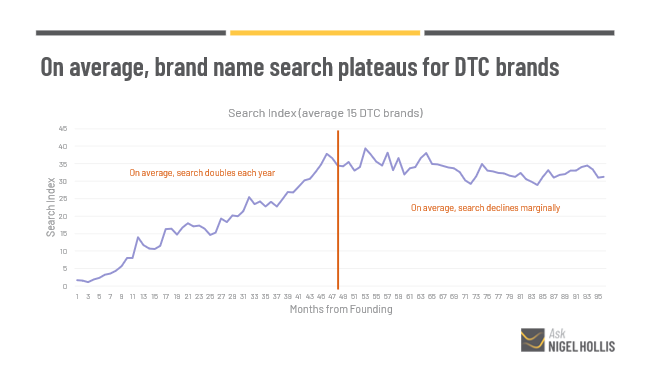
- Hollis’ analysis is based specifically on a basket of Direct-to-Consumer (DTC) brands and brand name searches over the 95 months following their founding.
- “On average, brand name search doubles each year for the first four years. However, between years four and five the average trend changes dramatically and begins to trend down marginally,” Hollis writes. “That means they need to start thinking about how best to build their brand at the end of the third year.”
In context
- Hollis’ analysis, which will be of great use to early stage brands working out what to do next as well as to established brands looking to strengthen the argument for building demand, chimes with a framing of brand building in harder-nosed terms than ‘brand’, as explored by James Hurman in a WARC whitepaper in 2021 and fleshed out more broadly since then.
- The thinking goes that when a radical new product (or channel, like DTC) arrives, a successful innovation will likely find a group of consumers that needed that problem solved but just needed a company to exist in order to buy.
- Then, that natural pool of customers runs out and new customers become more difficult and expensive to find; Hurman noted that, anecdotally, this tends to happen around three years from launch. This is when you need to have started building future demand among an audience that is not ready to buy yet but may realistically come into the market in the future.
- “When future demand creation and existing demand capture happen concurrently, growth is sustainable and sustained,” Hurman writes.
Sourced from Ask Nigel Hollis, WARC
[Image: Nigel Hollis]

The AI perception gap
Artificial intelligence has been a part of the mainstream conversation since the arrival of OpenAI’s ChatGPT in late 2022, but while the technology is becoming more powerful, users are also coming to terms with its limitations.
The crux of the matter
Generative AI is understood to have great potential if you need to produce a lot of text or imagery. Using a publicly available beta version, like the free ChatGPT that many people have tried, obscures the big costs of running an AI system. This is especially true when models are much less accurate than they need to be, as they don’t have robust oversight over what AI systems are producing.
Cycles of hype follow a pretty predictable curve when excitement dissipates once the rubber hits the road and a technology’s limitations become clear.
Research points toward impact-optimised image generation
First, the good news. Lumen reports positive results from a trial of AI creative tools with Diageo which could be optimised for “difference” performance metrics. In this case, the attention the ads commanded were “significantly” more than in Lumen’s average benchmarks.
For marketers needing to generate not ideas but sheer output rather than creative strategies or platforms, the signals are positive.
Or at least, positive for a balance sheet. Lumen also notes a 2023 Kantar study showing that on certain brand metrics AI had the potential to be at least as good as human-made creative. On the surface, this looks a lot cheaper at the HR level.
But costs are ramping up. You may be able to sack your creatives, but with demand soaring for AI-skilled engineers there may be a different set of costs to consider. Not least environmental, as the sheer amount of computing power increases.
Stanford AI index: money and nerves
Concerns about cost will be clear to readers of Stanford’s AI Index, which puts some numbers behind the staggering computing costs needed to train an AI – costs that are only rising as models get bigger. “OpenAI’s GPT-4 used an estimated $78 million worth of compute to train, while Google’s Gemini Ultra cost $191 million for compute,” notes the AI Index report.
There is, admittedly, a lot of money flowing in. Funding for GenAI has octupled since 2022 to reach $25.2bn. But investors are not the public, 52% of whom express nervousness about AI coming to products and services – a 13% year-on-year increase.
With figures so large required, industry leads the academic or government in development by a long, long way. But industry brings with it challenges: companies need to make sure their models look (and, vitally, sound) impressive to clients and imposters. Robust, standardized evaluations of LLM responsibility are scant.
AI is going to take longer to generate returns than thought
Data from ETR, a research firm specialising in an ongoing panel of tech decision makers, finds that gaps in the rate of application of this new technology are emerging, despite the majority (80%) of companies surveyed having evaluated the potential applications of AI in their business.
Unsurprisingly, leadership tends to be much more optimistic than the experts, with some of the biggest gulfs found in the expected short-term returns (three months) – a timeframe in which 21% of C-suite leaders expect returns compared to just 10% of experts. This is based on a smaller subset of respondents at companies that have “implemented” generative AI features.
“I do think the hype cycle, because of how quickly it moved, the pendulum is stalling and swinging back a little bit,” explained Erik Bradley, ETR chief strategist and research director, in comments to Sherwood, a business news website. “People are recognizing it's still important, it's still going to be there. It might not be the panacea, the savior of their enterprise at this stage.”
Sourced from Lumen, WSJ, WARC, Stanford, Sherwood

London marathon greets a new cohort of fashion-forward running brands
London marathon greets a new cohort of fashion-forward running brands
Major sportswear brands have long blurred the line between function and fashion, but as long-distance running gains popularity, a new generation of design- and community- led brands are entering the running – and wider sportswear – space with a different playbook.
Many are looking to this weekend’s marathon and other running events later this season to deploy it.
Why sportswear matters
Dominated by major brands, the sportswear market has seen and anticipates consistent worldwide growth. While new upstarts share some of the same drivers as the big brands – distinctiveness and performance – they differ in their focus.
In part, they are looking at helping serious runners stand out, with the Financial Times calling it a “fashion week for the running community”. These efforts often end up tying encounters with a brand to a sense of participation and community. But they are also looking to a smaller, often more committed niche than the broad swathes of interest sought by the big players, as they wrap their logos around global events.
Availability, then, stems from the know-how, the reality of having earned your stripes as an athlete.
Fashion and performance chases a key consumer segment
Taken as part of a deeper athleisure trend, which is the fastest growing category in fashion, according to GWI, there’s a distinctly fruitful audience to be found here. As GWI’s Ben Butling wrote back in November, they tend to be affluent individuals “happy to gloss over a higher price tag if it means access to fashionable items that look good, have the quality to match, and make them feel a part of a social tribe.”
Brands at the edge
The FT foregrounds a handful of brands operating in this emergent design-led running space. There are upstarts, from creative people who spend a lot of time running, such as the clothing brands Soar, Satisfy, Pruzan and the apparel and eyewear brand District Vision. And then there are bigger brands like New Balance who will hold a fashion week-style party on the Thames to coincide with the London Marathon.
Why it works
The trend is interesting due to what one founder, Tim Soar of Soar, calls the “festivalisation” of the sport, including additional events like panel discussions and post-race after parties, complete with some brands stocking high-end finisher specific t-shirts that tie the brand and the product to the experience.
It’s a tried and tested method in the space, and follows a model of niche-led sustainable growth typified by the runner’s darling brand, Hoka.
Following a spike in the popularity of running over the pandemic, Hoka kept its distribution to specific shops to grow loyalty among the community of the sport and assiduously avoiding overstocking, unlike a lot of other brands offered on the mass market. This maintained the premium perception of the brand – and, of course, margins.
Background
The rise of design-led or fashion-forward running brands chimes with a longer term trend in fashion of urbanites in activewear, which The Cut termed Gorpcore back in 2017. (The ‘Gorp’ element refers to the popular American hiking snack ‘Good Old Raisins and Peanuts’.)
If you live in a city and have noticed a lot of urbanites wearing hardcore outdoor brands like Patagonia or Arc’teryx, it’s likely as a result of the rise of Gorp.
More recently, Cosmopolitan observed in January that the outdoor/performance trend has melded with the Succession-era tendency of quiet luxury, to form a kind of stealthy outdoors made up of eye-wateringly expensive performance gear.
Sourced from the FT, WARC, NY Mag, Cosmopolitan, GWI, Statista, Retail Brew. Image: Pruzan
McDonald’s: A creative effectiveness transformation journey
McDonald’s: A creative effectiveness transformation journey
Even brands as big as McDonald’s need to go through periods of reinvention and transformation, and for McDonald’s its most recent changes have been internal as well as external.
A new WARC Creative analysis takes a look at the impact of a re-prioritisation of creativity across the entire organisation, using data from the WARC Rankings and with commentary from a session the McDonald’s CMO, Morgan Flatley, gave at a recent WARC event in New York.
What’s changed?
McDonald’s has shifted in recent years from an extremely operationally focused organisation to one where creativity has a seat at the table in the boardroom and one that promotes creative courage. The fast food retailer can translate this directly into growth – $30bn in topline sales growth on a base of $100bn since the pandemic – outsized growth attributed to the focus on creative marketing.
The shift has resulted in the best year ever in the WARC Rankings for McDonald’s: 1st for effectiveness, 3rd for creativity and 3rd for media. And the first time a brand has ever ranked in the top three across all three rankings.
Why does it matter?
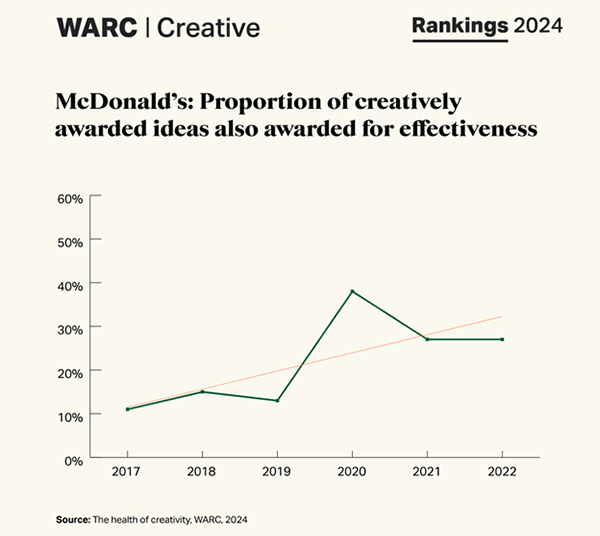
We know that creativity supercharges effectiveness from the many studies out there, but this is a specific brand example that can be linked to business growth. McDonald’s has increased the contribution of creativity to its effectiveness, raising the conversion rate from creatively-awarded work to effectiveness from 11% in 2017 to 27% in 2022.
A final word
“My advice is sometimes you have to take big swings in order to see that kind of momentum and help push an organisation out of what could potentially be a stuck moment to start to see the power of great creativity” – Morgan Flatley, CMO, McDonald’s.
WARC Creative members can read the full analysis here.

AdGreen triples measurement of ad productions in year two
AdGreen triples measurement of ad productions in year two
More companies are taking part in AdGreen’s efforts to track carbon production in advertising and more projects are being measured, according to the UK organisation’s latest annual review.
Key stats
- In 2023, the number of companies completing projects doubled from 2022, while the number of completed projects almost tripled to 1,424.
- 57% of top 30 UK creative agencies, and 72% of top 30 UK production agencies have contributed to a completed project. This is an increase of 10% and 33% respectively from 2022.
- Oliver takes the lead with 121 completed projects in 2023, and the greatest number of employees to complete AdGreen’s sustainable production training.
- There was a 1.5 tCO2e (metric tonnes of CO2 equivalent) increase in emissions in the average project size, compared to 2022, jumping to 6.2 tCO2e
- The average project size for productions with a budget over £50,000 per shoot day rose to 13.9 tCO2e, from 12.8 tCO2e.
- 72.1% of emissions recorded were attributed to travel and transport (air travel alone accounted for 60.2%), an increase of 9.7% from 2022.
Why advertising emissions matter
The latest data reiterates the need for the advertising industry to address unsustainable travel habits when creating content, particularly air travel, which generated 60% of the carbon emissions measured in the calculator in 2023.
And while generative AI may help solve some of these issues it’s by no means a silver bullet, as its environmental credentials are practically non-existent, consuming, as it does, huge amounts of electricity and water. A former Google executive has noted that “At some point the reality of the [electricity] grid is going to get in the way of AI.”
What next?
The AdGreen carbon calculator is being upgraded to include measurement of cloud storage, and virtual production where LED volumes are being used.
Sourced from AdGreen
[Image: AdGreen carbon calculator]

Events budgets are growing strongly
UK companies revised their marketing spend up once again in Q1 2024, with the latest IPA Bellwether Report showing events budgets expanding at the fastest rate on record.
Headline figures
- Almost a quarter (24.4%) of Bellwether panellists recorded an upward revision to their overall marketing budgets in Q1, compared to 15% that saw a contraction.
- The net balance fell to +9.4%, from +14.7% in Q4 2023, but this was still the second highest in almost two years.
By category
- Events was the stand-out category, recording a series-record expansion (net balance at +23.1%, from +15.9%) as companies continued to show a strong appetite for face-to-face engagement with customers.
- Direct marketing (+7.0%, from +12.6%) also extended its growth sequence, albeit with the upturn cooling slightly from its previous multi-year high.
- Sales promotions budget growth (+4.9%, from +1.4%) gathered further momentum in the opening quarter of 2024 – a possible red flag since overuse of promotions can undermine a brand’s profit margins and pricing power.
- Expansions of a marginal nature were seen in market research (+1.4%, from -5.0%) and PR (+0.6%, from +1.9%).
- Marketing budget declines were limited to just two categories in Q1, including the crucial main media segment (-0.7%, from +1.9%).
- Granular data on main media shows the contraction was driven by out of home (-10.8%, from -8.1%), published brands (-5.7%, from -1.4%) and audio (-4.5%, from -7.0%).
- This slightly offset growth in other online (+7.1%, from +13.2%) and video (+0.8%, from +6.6%).
Future plans
- Four in ten (40.7%) panellists have lifted the total amount available for marketing, compared to 18% reporting cuts. The resulting net balance of +22.8% signals strong budget-setting for 2024/25.
- The main area of marketing budget growth for 2024/25 is set to be events, with a robust net balance of +18.7% of survey respondents anticipating an uplift in spend compared to the previous financial year.
- Main media advertising is also poised for budget expansion in 2024/25, with a net balance of +10.1% planning to lift available expenditure in this segment.
- Market research (net balance of -4.4%), however, is set to contract.
- The Bellwether forecast for adspend to decline in real terms remains little-changed at -0.5% for 2024 (vs. -0.7% previously).
Sourced from IPA Bellwether

China’s tech giants power ahead on AI
China’s tech giants power ahead on AI
Recent announcements by China’s tech giants illustrate their different approaches to AI, with JD.com and Baidu trumpeting their proprietary tech while Alibaba is looking to the open-source development of its LLM.
What’s happening
- An avatar of JD.com’s founder and chairman, powered by the company’s ChatRhino AI, hosted two live-streaming sessions this week to promote consumer electronics devices and groceries.
- JD.com also reported that its AI-powered virtual streamers now cover more than 4,000 brands, according to the South China Morning Post.
- The Post also reports that Baidu’s Ernie Bot has gained over 200 million users, including 85,000 enterprise clients, in the 13 months since it launched.
- Alibaba reports that its Tongyi Qianwen LLM “has risen to a higher level than before” after it opened access to its 72-billion parameter version (Baidu’s CEO, however, believes there are too many open-source AIs in the market).
Why it matters
The debate on the best approach will no doubt continue but what’s already clear is that AI is going to reshape aspects of China’s digital life. JD.com claims its virtual streamers, for example, have slashed costs by as much as 90% compared to running sessions with human hosts, while the tech can also handle 70% of frequently asked questions. That spells trouble for the 15 million professional hosts working in the short video and livestreaming sector.
Key quote
“[The] LLM itself doesn’t create value directly, and only AI apps developed [using LLMs] can meet the real market demand” – Robin Li Yanhong, co-founder and chief executive at Baidu.
Sourced from South China Morning Post

Dove’s formula for purposeful creator tie-ups
Dove, the beauty brand owned by Unilever, is using a culture of feedback to build deeper relationships with its influencer community and further drive its brand purpose strategy.
Why impactful creator engagement matters
Working with influencers can enable brands to reach large audiences and drive awareness. Taking these relationships a step further, however, can have the effect of driving authenticity and engagement around a brand’s purpose, too. Achieving that goal rests on finding the right influencers and co-creating campaigns.
Takeaways
Firdaous El Honsali, Dove’s VP of external communications and sustainability, and beauty and wellbeing PR, influencer marketing lead at Unilever,...
This content is for subscribers only.
Sign in or book a demo to continue reading WARC’s unbiased, evidence-based insights that save you time and help you make marketing choices that work.
Email this content
